A Seattle-area nonprofit group known as the Fermi Explorer Mission today unveiled its plans to send a spacecraft on an 80,000-year trip to the nearest alien star system, Alpha Centauri.
If the mission goes as planned, it would mark a milestone for interstellar flight. But Philip Johnston, the group’s co-founder and president, doesn’t expect Fermi Explorer to be humanity’s first visitor to Alpha Centauri. He’s counting on our descendants to figure out faster ways to travel between now and the year 82026.
“We’ll be the first to leave, and the last to arrive,” he said.
The robotic spacecraft won’t be powered by antimatter, dilithium crystals or other science-fiction standbys for traveling between stars. Instead, it will depend on a tried-and-true solar electric propulsion system to build up speed for the 4.4-light-year trip.
Johnston and his teammates laid out the mission requirements for a bidding process that aims to keep the cost of designing, building, launching and operating the probe below $15 million. They’re also soliciting contributions, with launch targeted by the end of 2029.
The mission is contingent on raising the required funds, but Johnston voiced confidence about hitting the $15 million target. “We have raised significant funds already, but the bulk of the raise will kick off after [today’s] announcement,” he told GeekWire in an email. “One billionaire space founder already verbally offered $10M.”
What about NASA? “We are talking with NASA, but they have a very long process for backing missions,” Johnston said. “We would love to have them involved but will complete the mission with or without them.”
Johnston and the group’s other co-founders — Ezra Feilden and Adi Oltean — also founded Redmond, Wash.-based Starcloud, which plans to launch up to 88,000 satellites to serve as AI data centers. Johnston said there is no operational overlap between the two ventures.
Program manager Garrett Jameson, a former U.S. Air Force officer, will lead day-to-day operations. “We chose Garrett to optimize for something actually being launched,” Johnston said. “Rather than getting someone from JPL or an academic background, Garrett has 10 years of experience as an Air Force officer where he delivered on many missions, including space operations. His job will be selecting vendors and ensuring they deliver.”
Ten years ago, billionaire Yuri Milner announced a $100 million initiative called Breakthrough Starshot that aimed to send a swarm of micro-spacecraft to Alpha Centauri — but that effort, backed by the likes of Stephen Hawking and Mark Zuckerberg, never really got off the ground. Last year, Scientific American quoted the project’s executive director, retired Air Force Brig. Gen. Pete Worden, as saying that Starshot was put on hold.
“I spoke with the former program manager there,” Johnston said. “He was trying to do it in a human lifetime. Ours is a very different mission.”
The mission plan calls for the spacecraft to deploy from its launch vehicle and then loop around Earth and the sun to build up speed through a series of perihelion pumping maneuvers. When the probe reaches the planned escape velocity, it will head out for Alpha Centauri. “We will have a 12-year operation period … and then a 79,500-year coast period,” Johnston said.
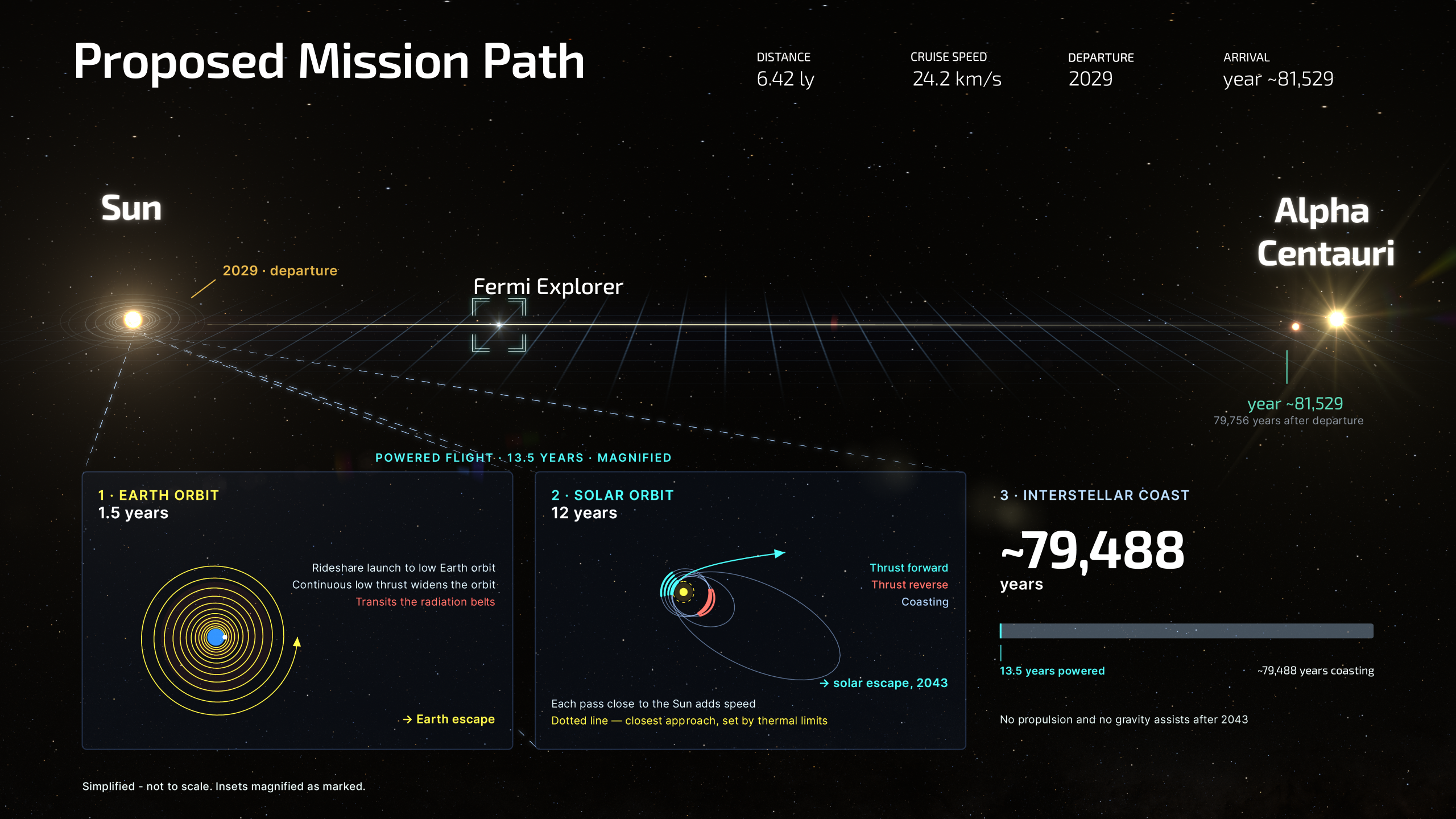
During the cruise, the probe will travel at a speed of 24.2 kilometers per second (54,000 mph). Johnston said the flight through the Alpha Centauri system will occur at a relative velocity of 17.9 km/s (40,000 mph) — roughly 25% faster than New Horizons’ Pluto flyby in 2015.
Specifications call for a minimum payload of 1 kilogram (2.2 pounds) inside a shielded 10-by-10-by-10-centimeter box (4 by 4 by 4 inches). The payloads could include artistic works or scientific experiments — for example, a cosmic-ray ion detector or an interstellar dust catcher. The Fermi Explorer team plans to schedule a three-month solicitation period for such payloads, and will make their selections based on feasibility, cost and other factors.
The team plans to send a digitized and micro-etched copy of the Voyager mission’s Golden Record, plus messages from children around the world. And the project offers several ways for supporters to “make their mark” on the mission, priced from $10 for a website mention to $1 million to place an gem-sized object on the probe.
“The purpose of messages from children is to inspire the next generation,” Johnston said in his email. “Grownups can pay.😅”
There’s no plan to orbit or land on a planet. Instead, the probe will continue outward after the Alpha Centauri encounter. Johnston hopes that future interstellar travelers will intercept it. “That is how we will get the data back,” he said.
The Fermi Explorer team conducted an AI-assisted analysis to verify that the plan was technically feasible. There’s also a board of human advisers, including Rob Meyerson, CEO of Seattle-based Interlune and former president of Blue Origin; Jeff Thornburg, CEO of Bothell, Wash.-based Portal Space Systems and former head of propulsion engineering at SpaceX; AstroForge CEO Matthew Gialich; Astro Digital CEO Chris Biddy; SpaceX engineer Ashkan Borna; and Alex Wissner-Gross, a physicist and inventor at the Massachusetts Institute of Technology.
“Philip and I have been talking about this idea for some time, and he asked me to support him as an adviser,” Meyerson told GeekWire in an email. “I believe in Philip as a leader, and big ideas like this need to be tried. I’m happy to be involved.”
Johnston hinted that SpaceX could play a key role. “We will most likely launch on a SpaceX rideshare, but that will be up to the vendor to select,” he said. When discussing the bidding process for providing the spacecraft, Johnston said that “we already have credible bids from U.S. manufacturers who have completed hundreds of successful missions” — a description that fits SpaceX’s profile.
Will Fermi Explorer actually lift off? The next few months should tell the tale. “The mission will happen,” Johnston insisted. “There will not be a no-go.”
There’s another, even deeper question about the mission: Why do it? Everyone involved in launching the Fermi Explorer will be long gone by the time it gets to Alpha Centauri. And there’s no guarantee that it will actually get there, or that humans will ever know if it does.
The answer lies in the name. “Fermi Explorer” is a reference to the Fermi Paradox, posed by physicist Enrico Fermi in 1950: If intelligent life is common in the universe, where is everybody? Some suggest that a “Great Filter” prevents species from expanding across the stars.
“I’m worried about the implications of the Fermi Paradox for the coming decades (i.e., are we coming up on a Great Filter),” Johnston said in his email. “I am doing the mission mainly to draw attention to the Fermi Paradox, and also to tick off a few more possible Great Filters.”
Learn more about the mission at FermiExplorer.org.