Subscribe to Positive Charge: Apple Podcasts, Spotify, Amazon Music, All Episodes
NEW YORK — Even as the environmental toll of the AI data center boom and geopolitical strife loomed over Climate Week NYC, business, nonprofit and government leaders gathered at hundreds of events across the city to look for hope in collaboration and chart paths forward.
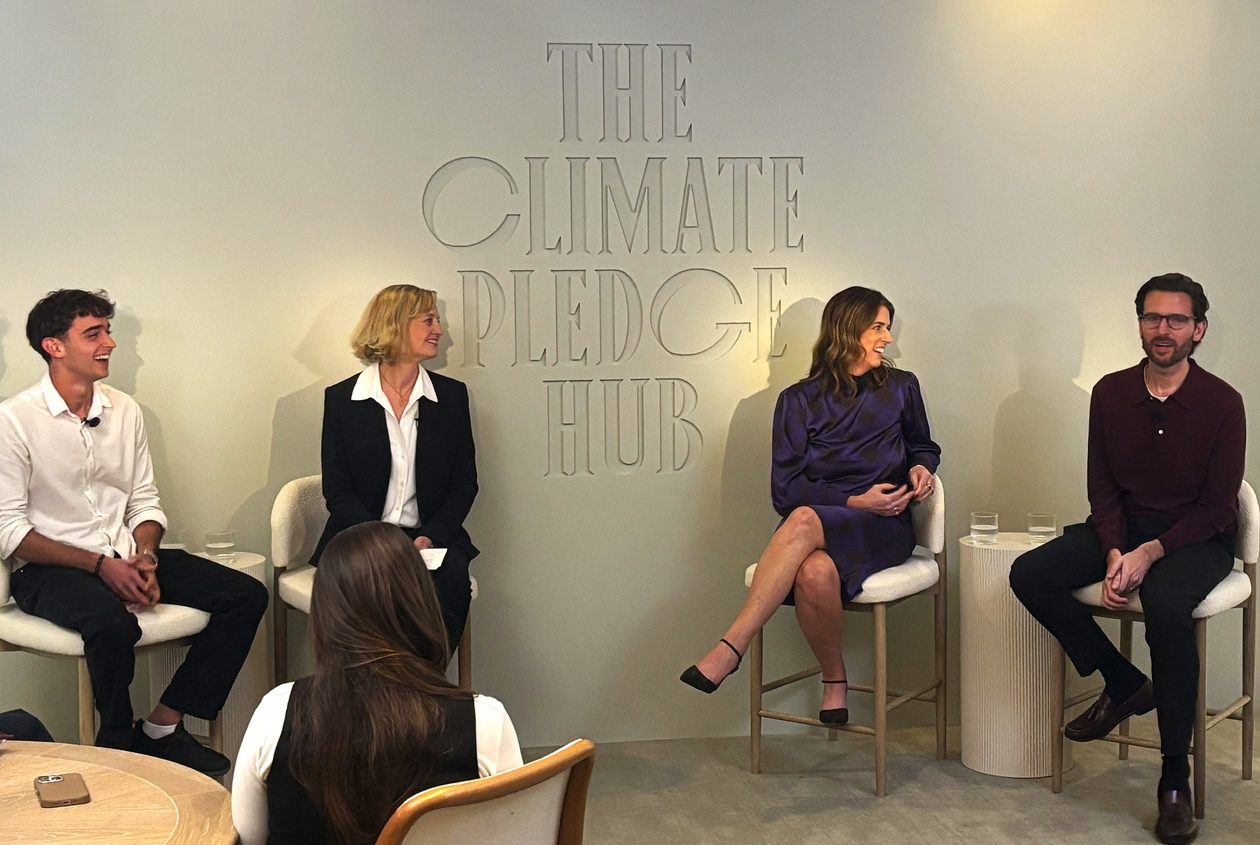
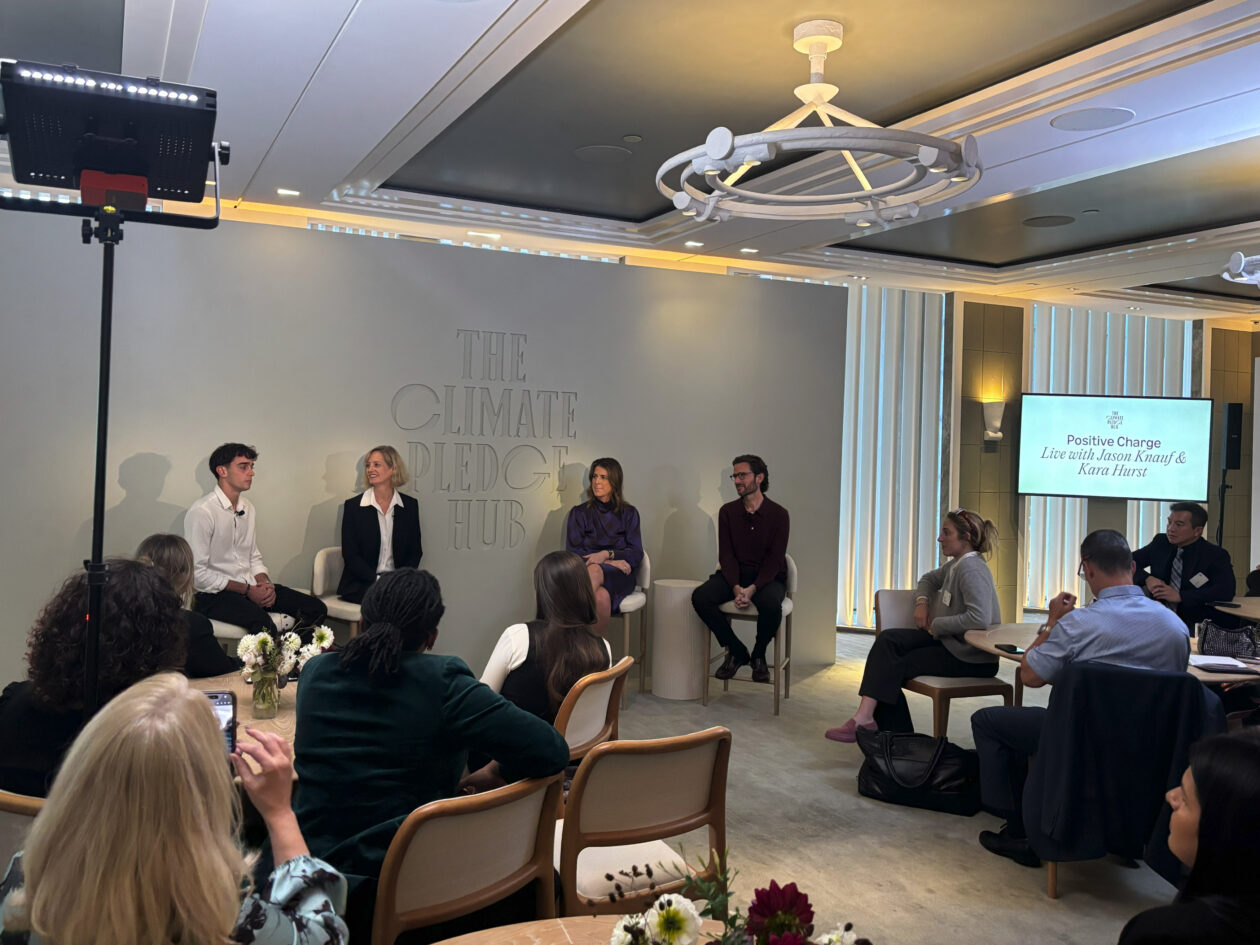
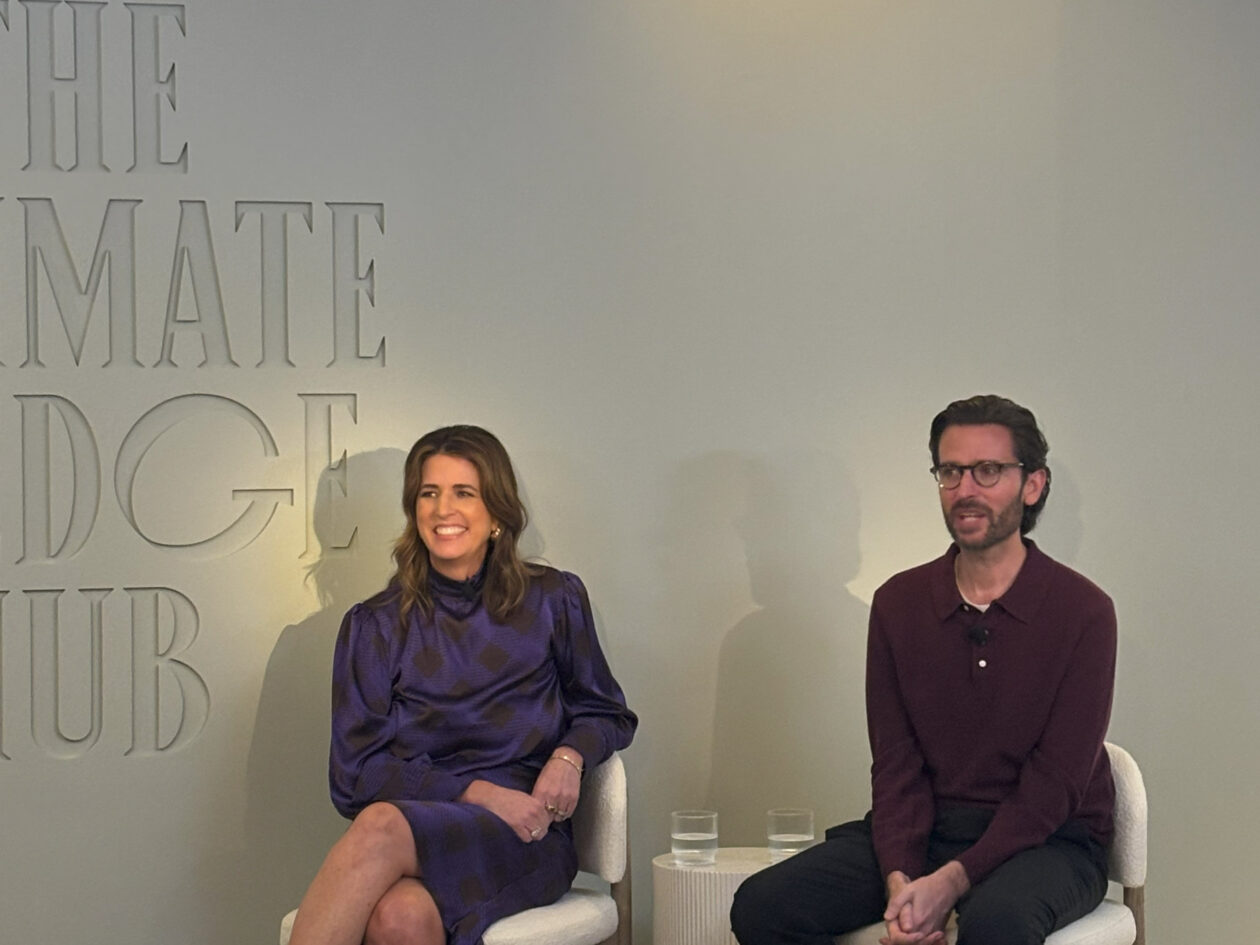
At The Climate Pledge Hub in Midtown Manhattan, executives from organizations worldwide that have vowed to cut their carbon emissions to net zero by 2040 met Thursday for a conversation on scalable climate solutions.
“There was a period of time where it was like, ‘Well, we don’t know how to do some of this,'” said Kara Hurst, chief sustainability officer for Amazon. The sustainability sectors have evolved. “The innovation has skyrocketed,” she added. “The number of people working on these industries is phenomenal, and so the solutions are available.”
Hurst was joined on the panel by Jason Knauf, CEO of The Earthshot Prize, a 10-year initiative launched in 2020 by Prince William, the Prince of Wales. The effort recognizes 15 finalists each year for their work on environmental solutions and selects five winners who each receive a $1.4 million (1 million British pounds) award.
Franco Rodríguez Viau, CEO and co-founder of Satellites on Fire and an Earthshot finalist this year, also participated as a special guest.
I moderated the session, which is available on GeekWire’s “Positive Charge” podcast and will be released as a video. Here are five highlights from the conversation:
AI boom vs. climate goals
Across Climate Week, attendees discussed serious concerns about the impacts of AI data centers — from the construction of new gas power plants to the carbon-intensive concrete and steel used in building them. The scale is massive. Amazon alone is spending $200 billion this year on data center expansion, and last year the company’s carbon emissions rose 16%.
The surge leaves many wondering whether net-zero goals for 2040 remain achievable. Hurst acknowledged the difficulty.
“So that is a real challenge,” Hurst said, “and we’re here to meet the moment. I’m not saying that it’s going to be easy, and I’m not saying it’s going to be linear. But we’re going to put everything we have behind that.”
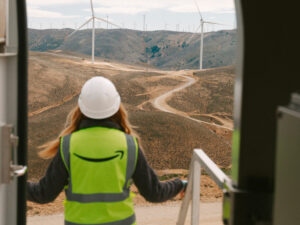
To counter those impacts, Amazon has invested in 700 renewable energy projects worldwide that can generate 42 gigawatts of power and continues to add facilities. The company is also procuring lower-carbon building materials, including mass timber.
“We are absolutely committed to our goal of 2040,” Hurst said, “and it is challenging.”
Power in numbers
Panelists said the key to addressing climate change and reaching carbon goals lies in partnerships that aggregate buying power to invest in and adopt clean technologies.
“We’re all trying to go as fast as we can at this climate challenge to decarbonize our operations, to change our businesses, to change the world,” Hurst said. “And here we have a collection of individuals trying to do the same with innovative solutions. So what we’re trying to do is partner up, highlight those and make them visible.”
That includes The Climate Pledge, which Amazon co-launched and has grown to more than 700 signatories, as well as the Zero Emission Maritime Buyers Alliance (ZEMBA), a buyer group supporting low-carbon maritime shipping.
Amazon Web Services, Earthshot and investment firm Plug and Play recently launched Velocity, a collaboration helping late-stage climate tech companies find customers. The program has two focus areas: materials innovation in sectors including fashion waste and construction; and energy independence spanning batteries, grid technology and other infrastructure.
Four Velocity winners will each receive up to $100,000 in AWS credits and their solutions will be promoted to Climate Pledge signatories.
And beyond its cash awards, Earthshot mobilizes a global network to help its portfolio of thousands of sustainable solutions find support through investors and corporate customers, as well as policy support for wider adoption.
Climate change as a unifying force
Addressing climate change is undeniably difficult and politically divisive, but Knauf said focusing solely on polarization misses the larger point. “The biggest story in the world right now is that this set of issues is the unifying mission in human history,” he said.
While climate impacts are felt acutely at the local level — whether from rising sea levels in Bangladesh’s Sundarbans mangrove region or along the beaches of Miami — the shared threat can bring people together rather than pull them apart, he added.
“Be open-minded. Talk to people who disagree with you. Don’t shut them down. Find common ground. Invite people in,” Knauf said.
Both Knauf and Hurst emphasized the need to lead with shared values that transcend politics. People across the political spectrum ultimately want a “healthy, livable planet for your children with clean air and clean water,” Hurst said.
Youth-led breakthroughs
Rodríguez Viau and two friends co-founded Satellites on Fire in Argentina at age 16 after family friends lost their homes to wildfires. Through interviews with firefighters and forest rangers, they learned that slow detection in remote areas was allowing blazes to turn catastrophic.
In response, they built a system using AI to analyze data from 13 satellites every five minutes, instantly sending location alerts to first responders via WhatsApp or text message.
“AI that we developed …. is nowadays detecting fires hours faster than NASA, which is the most used system globally for wildfires,” Rodríguez Viau said.
The startup, which launched in 2020, is operating in 21 countries on five continents and continues to expand its footprint.
Positive tipping points
Historically, the climate sector has focused on negative tipping points, such as the Amazon rainforest degrading until swaths of lush jungle turn into dry savanna. But new research from Earthshot and the University of Exeter in England highlights positive tipping points, such as solar power becoming so cheap that adoption grows exponentially.
The study identifies 51 sustainability objectives — restoring wetlands, preventing and composting food waste, and shifting to electric vehicles, to name a few — that can trigger rapid, favorable shifts to address critical environmental challenges.
“There’s some positive systems that if we actually put all of our efforts together and focus over the next few years, we know we can tip them into irreversible positivity,” Knauf said.
The final word
The session closed with a question asking what message or action should listeners take with them.
Knauf: “Invite people in. Let’s grow this movement. Let’s stop pushing people away. And use it to support each other and feel like we’re part of something bigger.”
Hurst: “When you find something that works, publish a case study. And when you find something that doesn’t work, talk about it also. Because we can move really fast when we know what the solutions are, but we can move really, really fast when we know what doesn’t work and we can avoid it.”
Rodríguez Viau: “I was listening when you were speaking about the 2040 goal, and I was thinking, ‘I don’t know if we will reach the goals that we want to reach or not, but at least I want to feel that I did everything I could.'”
Editor’s note: The Climate Week panel and this episode of Positive Charge were sponsored by The Climate Pledge and Amazon.
Sources and references
Interviews:
- Kara Hurst, chief sustainability officer for Amazon
- Jason Knauf, CEO of The Earthshot Prize
- Franco Rodríguez Viau, CEO and co-founder of Satellites on Fire
Additional sources: