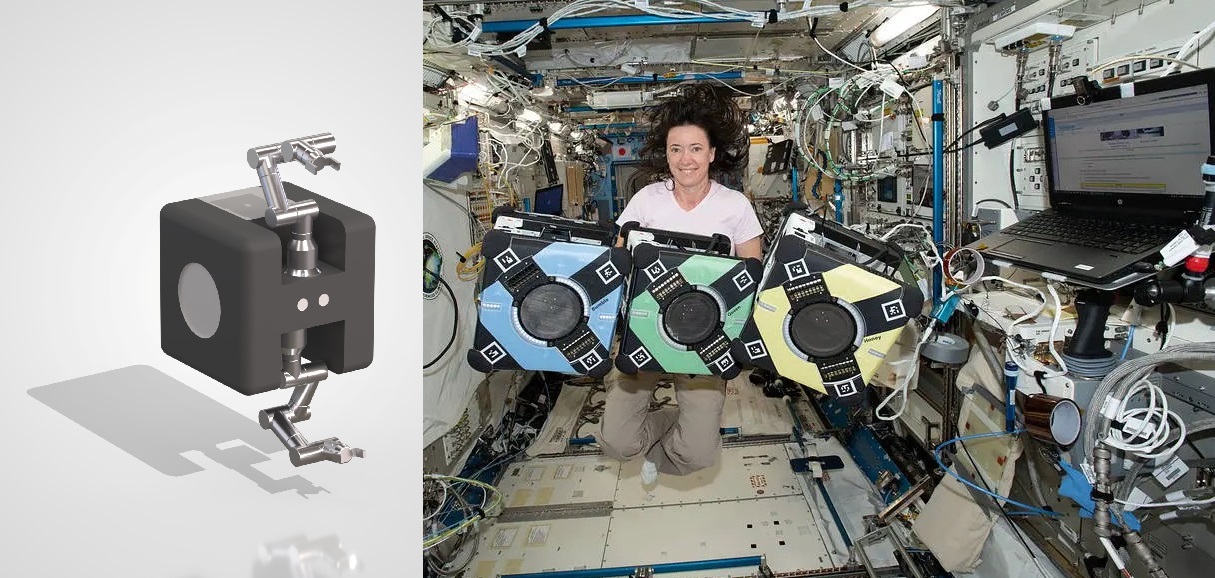
A free-flying NASA robot aboard the International Space Station will soon demonstrate a system for capturing and servicing satellites in orbit, using a pair of autonomous robotic arms built by Seattle startup Orbital Robotics.
“This demo will prove our ability to capture, manipulate and upgrade satellites on orbit, moving humanity one massive step forward towards reusable satellites,” Orbital Robotics CEO Aaron Borger said today in a news release.
Borger told GeekWire that the company plans to send its robotic arms to the space station in the third quarter of 2027. Three separate demonstrations would be conducted, each about a month apart, he said.
The mission will mark a major milestone for Orbital Robotics, which was founded in 2024 by Borger and other veterans of Jeff Bezos’ Blue Origin space venture, including lead hardware engineer Riley Mark, lead software engineer Sohil Pokharna and adviser Doug Kohl. Orbital Robotics has been developing arms controlled by artificial intelligence for use on free-flying spacecraft, and this will be the company’s first opportunity to prove out its capture technology and autonomous control software together in microgravity under real spaceflight conditions.
The demonstration is a joint effort with Arkisys, NASA’s sustaining and maintenance partner for the Astrobee program, which will provide integration support and in-space platform infrastructure. A successful demo would boost confidence that free-flying robots equipped with Orbital Robotics’ arms could conduct satellite servicing missions.
“Free flight proves you can get there, manipulation proves you can do something once you arrive,” Arkisys CEO David Barnhart said. “Pairing Astrobee with Orbital Robotics’ arms creates a powerful proxy for the servicing and assembly operations that will shape the future ISAM [in-space servicing, assembly and manufacturing] economy.”
Three cube-shaped Astrobee robots — nicknamed Bumble, Queen and Honey — are currently available for testing aboard the ISS. In 2024, one of the Astrobees was outfitted with a set of tentacle-like arms that grabbed onto a boxy cube to demonstrate the system’s gripping ability. Borger said the Orbital Robotics / Arkisys demo would be similar to the tentacle test.
Orbital Robotics’ arms for the Astrobee demonstration will be scaled-down versions of the ORA-A arm that the company has built in its Seattle lab, Borger said.
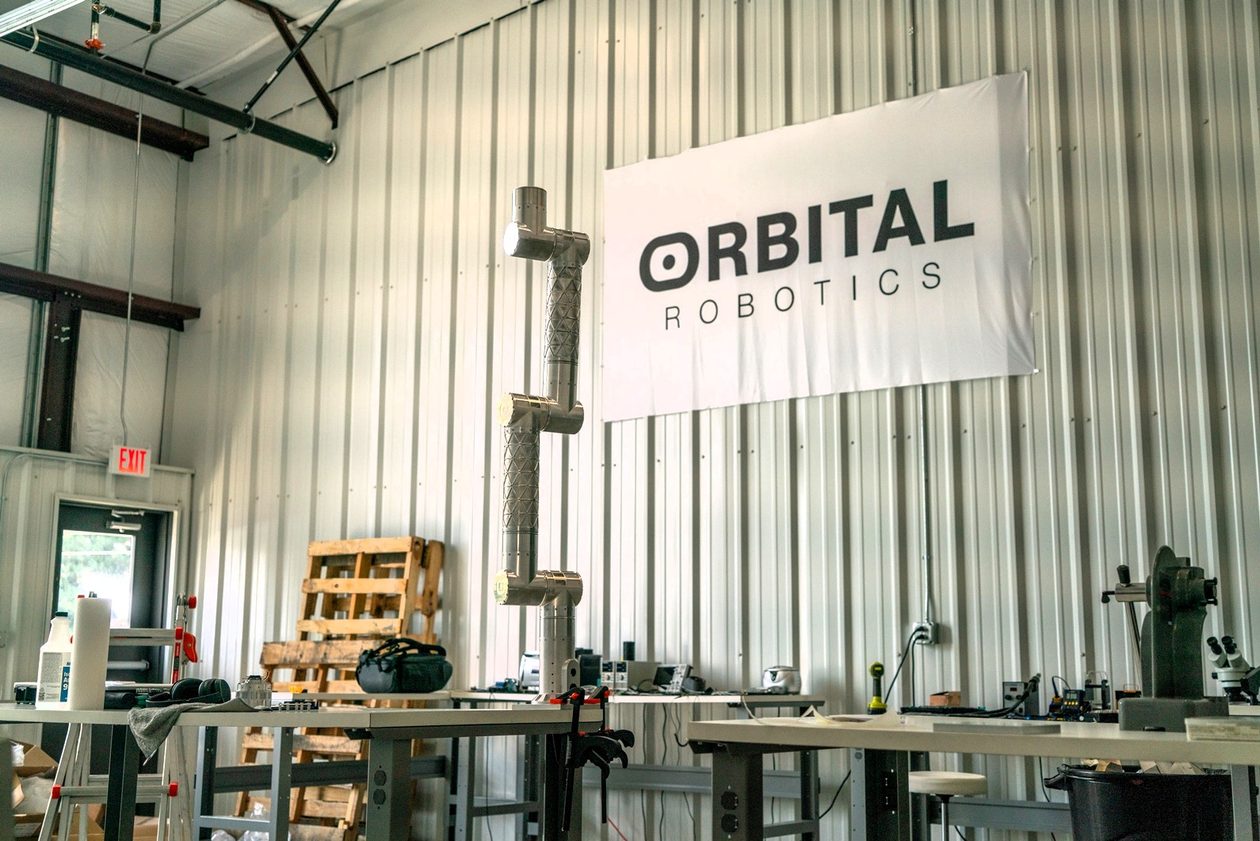
“The arms will be sent up to the ISS and then installed onto one of the Astrobees by the crew,” Borger said in an email. “The Astrobee with the arms will then demonstrate the capture and servicing on a second Astrobee that is already on the ISS. … After the capture, we will replace a simple compute module we will launch and integrate with the Astrobee being captured.”
Borger said the ISS demonstration is an internally funded program. “We are paying for the launch and demonstrations with Arkisys as our implementation partner through their Space Act Agreement with NASA,” he said.
After the demonstration, the arms will remain available aboard the ISS to assist astronauts with moving cargo, to automate simple tasks involving robotic manipulation, and to provide opportunities for roboticists to conduct follow-up experiments.
NASA and its commercial partners are already preparing for the next step in space robotics: The Fly Foundational Robots mission, due for launch in late 2027, will deploy a satellite equipped with a commercial robotic arm for demonstrations of in-space servicing tasks.