Seattle’s economic engine is stalling, and downtown is taking the brunt of the hit.
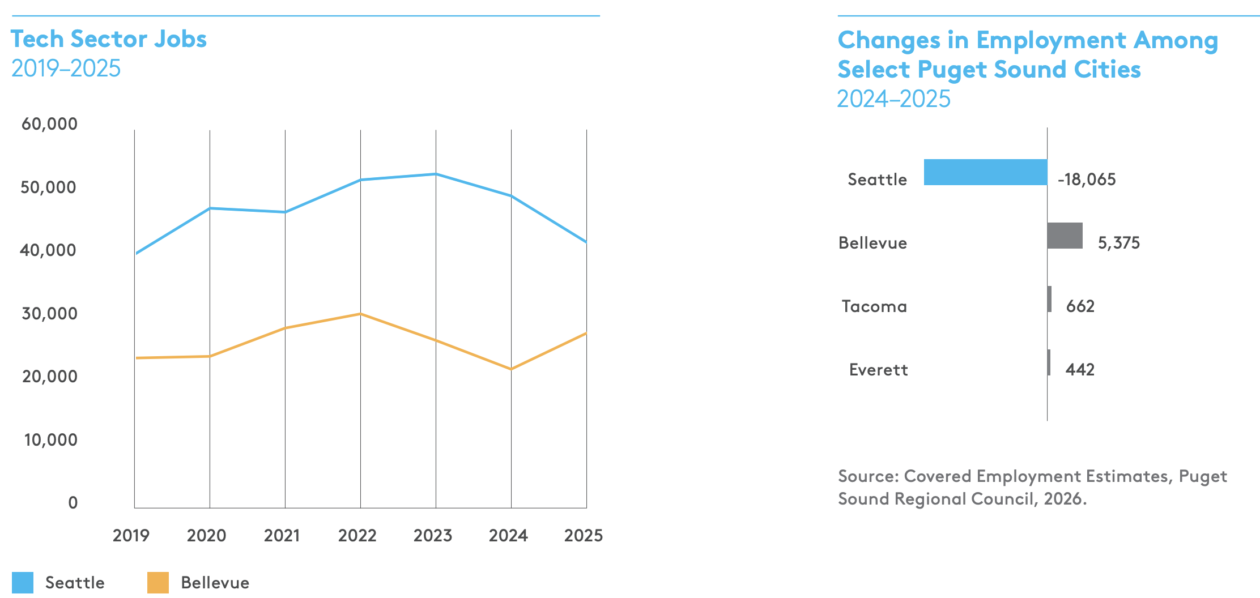
Between 2024 and 2025, Seattle shed 18,065 total jobs, with a staggering 70% of those losses—13,000 jobs—coming directly from the city’s downtown core, according to a new report released by the Downtown Seattle Association.
In some ways, it’s a tale of two cities.
While Seattle proper shrank, neighboring Eastside tech hub Bellevue gained 5,375 jobs over the same timeframe, highlighting a shifting center of gravity within the Puget Sound region.
A lot of that growth in Bellevue, and decline in Seattle is coming from one company: Amazon.
The online retail and cloud computing powerhouse employed 15,700 workers in Bellevue at the end of 2025, making it the largest employer in Bellevue at 9.85% of the total workforce, according to the city’s Annual Comprehensive Financial Report. That’s up from just a few hundred employees in Bellevue nearly a decade ago.
Amazon employs about 49,000 people in Seattle proper, though the Puget Sound Business Journal noted this week that the company has shed office space in downtown Seattle and dramatically slowed employment in the city.
Other key findings from the Downtown Seattle Association report:
- Tech Leads the Drop: Seattle’s sharpest sector declines were concentrated in Information and Technology, Professional Services, and Construction.
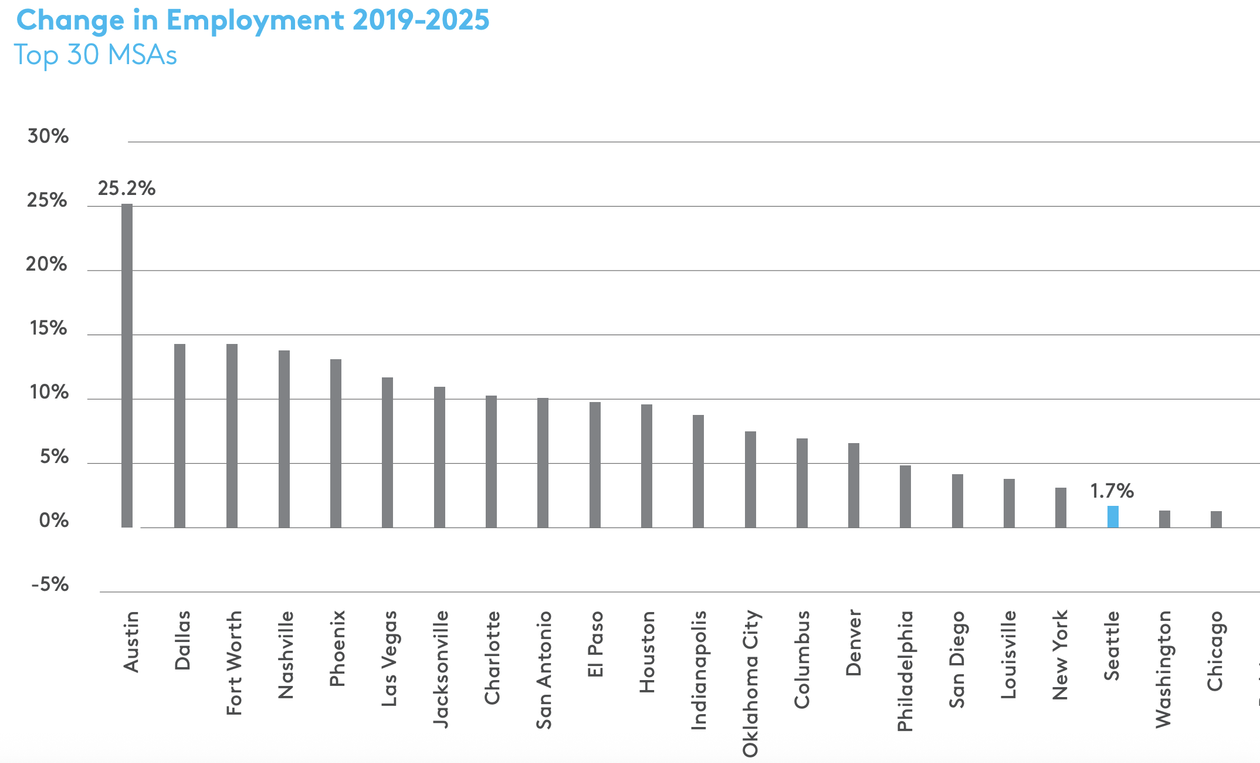
- National Lag: Out of the top 30 U.S. metropolitan statistical areas, the Puget Sound region ranked 20th in job growth between 2019 and 2025. Total regional nonfarm growth rose just 1.7% over six years, vastly underperforming peer markets like Austin (25.2%), Dallas/Fort Worth (14%), and Nashville (14%).
- Stagnant Commuter Foot Traffic: Inbound commuter visits to downtown Seattle remain stuck in the low 60% range compared to 2019 baselines, sliding 38% since the pandemic — a steeper loss than Bellevue (-21%), Austin (-23%), or Chicago (-32%).
- Intra-Region Tech Shift: While Seattle’s tech headcount dropped from its 2023 peak, Bellevue’s tech job totals surged upward between 2024 and 2025, regaining momentum.
The latest findings build on a growing chorus of criticism regarding the city’s fiscal climate. A June analysis by the DSA argued that Seattle’s controversial “JumpStart” payroll expense tax—passed in 2020 and targeting major employers like Amazon—is backfiring by driving business across Lake Washington.
The June report highlighted that since 2020, downtown Seattle lost roughly 30,000 jobs and saw office building values plummet 48%, while Bellevue—which levies no comparable head tax—gained jobs and expanded commercial values by 7%.
Though JumpStart projects $388 million in revenue this year, about 70% of that relies on just 10 major companies, underscoring how heavily Seattle leans on a handful of tech giants.
City of Seattle Mayor Katie Wilson has consistently pushed back against blaming downtown’s struggles on any single tax, pointing to broader post-pandemic remote-work trends, high interest rates and national tech restructurings that affect cities nationwide. She credited JumpStart with saving the city from drastic service cuts during the pandemic and noted that Seattle’s recovery remains resilient.
However, in a sign that Mayor Wilson is paying close attention to tech-sector headwinds and shifting job patterns in the region, she last week proposed a $9.1 billion 2027 budget, which would erase a $175 million general fund deficit and cut nearly $50 million in spending while freezing JumpStart tax rates.
Citing “seismic shifts” in the technology sector, the mayor’s freeze leaves the payroll tax untouched to offer big employers a period of tax stability, even as she continues directing JumpStart revenues beyond their original intent to cover core general fund operations.
“These were a set of taxes that may have provided some short-term gain to the city coffers, but are inflicting long-term pain,” DSA President and CEO Jon Scholes told GeekWire in an interview in June. “We predicted that at the time, and were sort of dismissed and ignored.”