Highspot’s branding is still everywhere inside its longtime headquarters at World Trade Center East, overlooking the Seattle waterfront. But outside the corner office that once belonged to the sales software company’s co-founder and CEO, “Seismic” is scribbled on the whiteboard.
That’s how fresh the merger is. Two weeks after San Diego-based Seismic took over its Seattle-based rival, Seismic CEO Rob Tarkoff is in town this week for the first board meeting since the combination was completed, and the inaugural gathering of the combined company’s senior leadership team.
Highspot and Seismic sell sales enablement software: systems that manage the pitch decks, case studies and training materials salespeople use, and track which ones help close deals.
Founded in 2011 by Robert Wahbe and two former Microsoft colleagues, Highspot raised $650 million and held the top spot on the GeekWire 200, our ranking of the region’s privately held tech companies, prior to the merger. Wahbe, its CEO until the deal closed, is now on Seismic’s board.
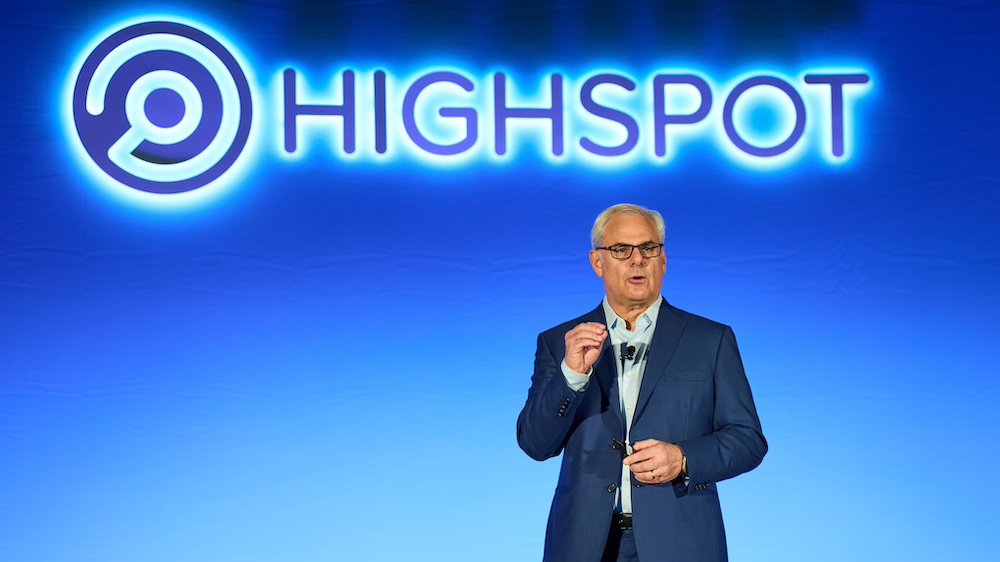
Tarkoff, a lawyer by training who spent much of his career in corporate development and M&A, became Seismic’s CEO in October 2025, succeeding co-founder Doug Winter. He had previously spent seven years running Oracle’s customer experience business.
The Highspot deal was announced in February, four months into his tenure.
Tarkoff addressed a wide range of questions from GeekWire in an interview Monday afternoon in Wahbe’s former office, which now serves as an ad hoc meeting room.
Here are the main takeaways from the interview:
A $600 million company: Tarkoff disclosed the combined company’s annual recurring revenue for the first time, putting it at about $600 million, with about $200 million of that coming from Highspot.
That makes the combined business three times the size Highspot was on its own and 50% bigger than Seismic. Tarkoff said the larger size will be an adjustment for people across both companies as they come together. “We’re getting closer to being a billion dollar company,” he said.
The companies did not disclose the financial terms of the deal, and Tarkoff declined to say whether the transaction put Highspot above or below the $3.5 billion valuation it reached in 2022.
Tim Porter, managing director at Madrona, which led Highspot’s Series A in 2014, called it a “multi-billion-dollar merger” in a post after the deal closed. Porter, who serves as a board observer at Seismic following the combination, wrote that Madrona hopes to help build the combined company into “a truly iconic AI software company, through a potential IPO and beyond.”
Permira, the private equity firm that has backed Seismic since 2020, remains the controlling shareholder of the combined company.
Impact on jobs: Seismic said when the deal closed that Highspot had more than 700 employees and that the combined company would have about 1,700 total. Tarkoff said in a statement at the time that the companies were “carefully evaluating our organizations to identify areas of overlap,” and that “any decisions will be communicated directly and proactively to employees.”
Since then, word of initial job cuts has started to emerge on LinkedIn and other online forums, but the company has not provided specifics or disclosed any numbers.
Asked for an update on job reductions this week, Tarkoff said, “We did our best to try to find roles for everybody that we could, but there’s always some level of overlap where you don’t need two people doing a task that requires one.”
Tarkoff did not provide numbers or address the question of whether more job cuts are coming. He said the company feels “really good about where we are from a go-forward staff perspective,” while adding: “We will continue to push performance and push growth and acceleration.”
Seismic’s future in Seattle: Tarkoff said Seismic will keep Highspot’s Seattle offices at World Trade Center East, where the company has a long-term lease. He called Seattle “one of the top centers of excellence for tech talent,” citing the ability to recruit from Amazon, Microsoft and others.
There will be no designated Seattle site leader, he said, describing the office as one of the company’s major centers rather than a headquarters.
However, several senior leaders of the combined company are based in Seattle, including Kurt Berglund, who led engineering at Highspot and is now Seismic’s senior vice president of AI.
Others include chief human resources officer Kimberly Schultz, who joined Seismic in June after 11 years at Amazon, where she led the team responsible for integrating acquisitions and divestitures, and Lucas Welch, VP of brand and communications, who spent nearly eight years at Highspot.
Tarkoff said a number of the company’s top engineers are based in Seattle as well.
Seismic’s other major locations include San Diego, Boston, Toronto, Vancouver, B.C., London and Hyderabad, India, where Tarkoff said the company has more than doubled its presence. Gurpreet Singh Pall, who was Highspot India’s chief operating officer, now leads Seismic’s India operations.
Product plans: The current Highspot and Seismic platforms both will continue to be sold and supported for the time being, Tarkoff said. He declined to set a timetable for eventually consolidating them, saying customers will move to a new platform when one is ready.
Now that the companies are able to work directly together, he said they’ve come to see that the two products are closer than he understood before the deal closed. Seismic has focused on complex enterprise workflows and regulated industries, financial services in particular, while Highspot built for a broader market of upper mid-market and lower enterprise customers.
With two teams no longer building the same things, he said, engineering can move to new work — more AI agents, additional content governance features, and deeper industry-specific workflows such as archiving and records retention.
Rivals are making the opposite case. Ali Akhtar, CEO of Letter AI, wrote in a LinkedIn post last week that mergers in the category turn companies inward for quarters or years, predicting “stalled innovation, layoffs, and distractions from delivering customer value,” and a period of reduced support for customers on legacy platforms. Akhtar is offering to buy out their contracts.
Pricing: Tarkoff said seat-based subscriptions aren’t going away, because enterprises want predictable costs. He said he’s skeptical of the usage-based pricing some AI vendors have adopted, pointing to high-profile examples of companies blowing past their budgets.
“Token-maxing is not really a good model long term, because it’s just going to force enterprises to use less,” he said.
He said Seismic is working toward pricing tied to outcomes rather than usage.
The Salesforce question: A week after the Seismic-Highspot merger closed, Salesforce and Anthropic announced Claudeforce, making Claude the default model across Slack and parts of Salesforce’s Agentforce platform.
Salesforce is both a channel and a rival for Seismic. Seismic’s software sells through the Salesforce AppExchange, and its Aura AI runs inside Agentforce, Salesforce’s agent platform. At the same time, Salesforce’s Sales Cloud includes its own sales enablement tools. And Agentforce agents increasingly do work that enablement platforms have owned.
Asked whether the partnership makes Salesforce a tougher competitor, Tarkoff said no.
As sellers start working inside Claude rather than inside individual applications, he said, the assistant will call each company separately — Salesforce for customer records, Seismic for approved content and sales materials. That makes Seismic a peer of Salesforce inside Claude, rather than an add-on inside Salesforce’s own product.
“It actually puts us more on an even playing field with Salesforce,” he said.
But Salesforce is considerably further along. Claudeforce launched with a Salesforce plugin carrying 37 prebuilt sales skills, in pilot now and due in open beta this month.
Much of the early analysis of the Salesforce-Anthropic partnership saw it as evidence that enterprise AI is consolidating around a few deep platform alliances rather than opening up.
Seismic’s next fiscal year begins Feb. 1. Tarkoff said he expects to spend much of the intervening months on the road with customers and employees. Seismic plans to give the first detailed look at its new product roadmap at its Shift conference, Oct. 12-15 in Carlsbad, Calif.