One of the hottest infrastructure companies in AI today is a startup established nearly seven years ago, tracing its roots to work its founders were doing before the cloud was a thing.
Temporal, based in Bellevue, Wash., announced this week that it raised $550 million at a $12.55 billion valuation, led by Lightspeed, more than doubling its $5 billion valuation in February. Its software is used by OpenAI, Nvidia, Netflix, Snap and JPMorgan Chase, among more than 4,300 paying customers, and its annualized revenue run rate recently passed $250 million.
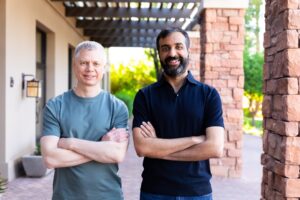
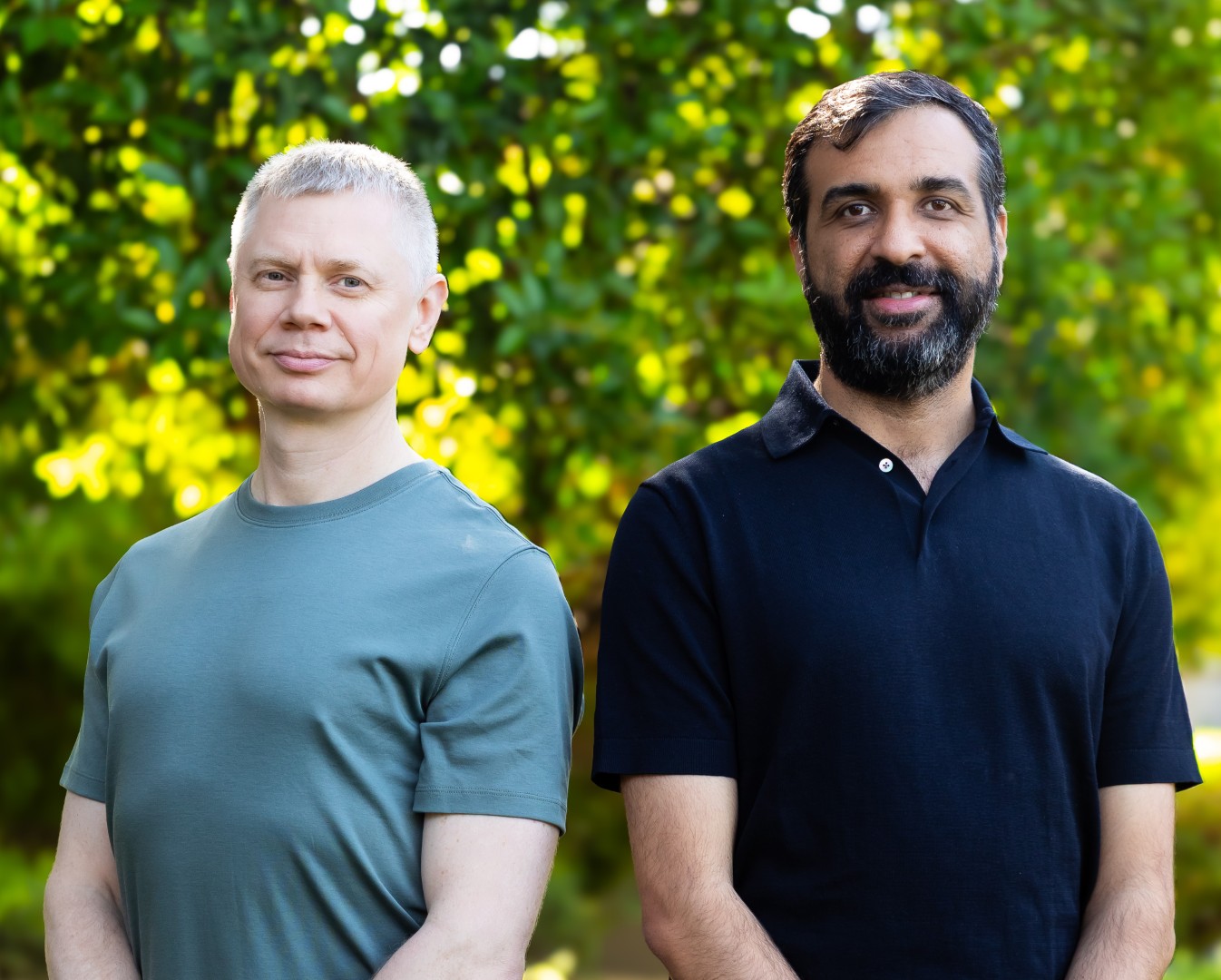
It might seem like an overnight success, but it’s not, said Samar Abbas, Temporal’s co-founder and CEO, speaking along with co-founder and CTO Maxim Fateev in an interview with GeekWire this week. They first met at Amazon in 2010, where they worked on Simple Workflow Service, an AWS product for coordinating long-running tasks across distributed systems.
“We’ve been hacking away at this problem for 20-plus years now,” Abbas said.
The problem: software that runs in many steps across many machines breaks in the middle, and picking up where it left off is far harder than it sounds. Their answer, for which they coined the phrase “durable execution,” records each step as it completes, so a program survives a crash or a failed outside service, and finishes rather than starting over or leaving the work half-done.
“It’s core infrastructure. You really cannot go and build it very fast,” Fateev explained. “It took us years and years to get to the point where we knew what we were doing.”
It’s also especially well-suited for AI agents, which is why a company built for the cloud era is suddenly at the center of the AI boom. Agents can sometimes run for hours or days, calling models and outside tools that fail routinely. Keeping everything together regardless is Temporal’s role.
“Every Snap story is a Temporal workflow,” Abbas said. “Every time you place an order at a Taco Bell, all of the steps get orchestrated on top of our platform. Some of the most popular coding agents out there are using us as an outer harness. It’s a pretty exciting time for us, from that perspective.”
Pacific Northwest roots: Founded in October 2019, Temporal employs 570 people, roughly double from a year ago, with 89 in the Seattle area. The company is fully remote. Its Bellevue office, previously occupied by OpenAI, is used mainly for meetings rather than daily work.
But the founders describe the region as instrumental to the company’s success. Both have been in the Seattle area for more than 26 years, and they’ve built their entire professional careers here.
- Abbas spent 11 years at Microsoft before joining the Simple Workflow Service team at AWS in 2010, then returned to Microsoft and wrote the open-source library that became Azure Durable Functions, leaving for Uber’s Seattle office in 2015.
- Fateev built the messaging infrastructure behind Amazon’s Simple Queue Service starting in 2004, and later led the architecture of Simple Workflow Service, before going to Google and later reuniting with Abbas at Uber.
When GeekWire first wrote about Temporal in 2020, a year after Abbas and Fateev left Uber, it had 15 employees, $25.5 million in funding and no paying customers. Sequoia Capital led the $20 million Series A, with participation from Seattle’s Madrona and others. Bob Muglia, the former Snowflake CEO and longtime Microsoft executive, was an angel investor. Snap and Box were early users.
Fast-forward to today, and the company has raised $1.2 billion in total funding. Temporal ranks No. 2 on the GeekWire 200, our list of the top Pacific Northwest startups, behind only Everett fusion energy company Helion, valued at $15.5 billion.
“The kind of talent that we have here in the Pacific Northwest is insane,” Abbas said, citing factors including the deep bench of cloud engineers from Microsoft and Amazon. With another platform shift now underway, he expects the same advantage to apply to AI infrastructure.
The larger question of AI safety: Temporal’s milestone comes amid a growing industry debate over the pace of AI development, and incidents in which AI agents have gone rogue, escaping the systems meant to contain them, including the latest examples from OpenAI this week.
Abbas said he sees those failures as accountability problems more than model problems.
“As you dig into each and every one of the incidents that have happened in the last three months, it always comes down to no one really knowing what these AI agents did, step by step,” he said.
Part of Temporal’s pitch is that it can make those failures traceable. Temporal records every step as a program runs, leaving a log of exactly what an agent did, in what order, and where it stopped. Abbas said that also creates a place to intervene, inspecting or blocking an action before it executes.
“We can put the agent in a much, much tighter jail,” Fateev said.
“I’m not going to sit here and tell you we solve AI safety,” Abbas added, calling that the job of the labs that create the models. But a company’s ability to know what its agents did, and to keep them from doing more than they should, is a specific challenge that Temporal can address.
“That’s truly an engineering problem,” Abbas said, “and it’s very solvable today.”
Customers and competition: Bloomberg reported in August that OpenAI is Temporal’s largest customer. Asked whether it’s too dependent on the ChatGPT maker, Abbas said no. The labs are moving fast and driving usage, he said, but the similar growth trends are starting to show up across the rest of the customer base. Abbas said 18 of the top 30 AI-native companies use Temporal.
The AI labs and cloud providers sell their own agent frameworks, and some are getting into the reliability work that Temporal does, which means its biggest customers could become competitors.
Fateev’s answer is that enterprises don’t want to be locked into one provider, one model or one vendor’s idea of how agents should work. Temporal is open source and takes no position on what a customer runs on top of it, which matters given seemingly constant changes in the tech stack.
The founders also see an opening in how AI systems connect to one another.
Agents increasingly have to call other systems, and each other, to get anything done. Fateev said the standard ways of wiring those connections (such as Model Context Protocol) assume the work finishes in seconds, and fall apart when a job runs for hours or days, or has to be unwound after something fails. Temporal is built for that kind of work, and can serve as an underlying foundation.
What’s next: Temporal plans to put a big chunk of the new funding into research and development, extending the “durable execution” technology at the core of the platform.
Today, the company tracks an application’s state from the outside, coordinating work that runs elsewhere. In the future, Abbas said, Temporal wants to provide the computing power, too, hosting the agents on its own platform rather than simply directing them on others.
Big business customers have been pushing for stronger security and auditing, another target for the spending. Temporal is also expanding a project called Nexus, which lets teams call each other’s workflows without giving up the guarantees that make the platform useful in the first place.
The company plans to expand internationally, where it does a small share of its business today, and to keep hiring after doubling its headcount over the past year. Abbas said the company’s growth defies the popular wisdom that AI companies don’t need significant human talent.
In the meantime, the founders remain very much engaged with the problem they’ve been trying to solve in one form or another for the past two decades. Temporal’s open-source Slack channel has about 25,000 members, and Abbas said Fateev is still in there mixing it up himself.
“You ask a question,” Abbas said, “I’m pretty sure Max will jump in within the first five minutes.”